
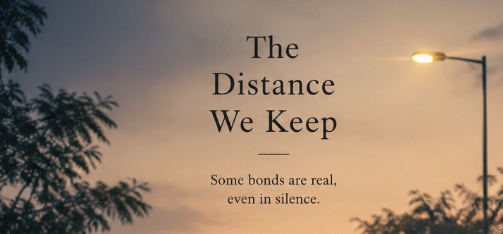
There is a dog who follows me, though I have never asked him to.
I first noticed him on an evening that had already begun to fade into memory. The sky carried that dull grey which belongs neither to day nor night, and the streets seemed tired of holding footsteps. I was returning home, thinking of nothing in particular, when I heard the faint sound of paws behind me. Not hurried, not cautious, but steady.
When I turned, he stopped.
He was not remarkable in the way people notice things. His fur was uneven, dusted with the color of the road itself. His eyes were neither pleading nor afraid. They held a kind of quiet patience, as though he had long ago accepted something I had yet to understand.
I walked again, and so did he.
At first, I thought it was accidental. Dogs wander, after all. They belong to no one and everywhere at once. But the next day, and the day after, he appeared again. Always at a distance that felt deliberate. Not close enough to demand, not far enough to disappear.
It troubled me, though I could not say why.
One evening, I stopped at a small shop and bought a packet of biscuits. I do not know what compelled me. Perhaps it was guilt, or perhaps it was curiosity dressed as kindness. I placed a biscuit on the ground. He approached slowly, watching me as if measuring my intentions rather than the food itself.
When he ate, it was without urgency.
That, more than anything, unsettled me.
I had seen hunger before. It is usually loud, desperate, impatient.
But his hunger was quiet.
It asked for nothing, and yet it remained.
From that day on, it became a habit. I would carry a few biscuits with me. I never called him. I never tried to touch him. And he never came too close. We maintained, without speaking, a distance that felt almost respectful.
It was not friendship, at least not in the way people understand it. There were no gestures, no affection.
Only presence.
Days quietly became weeks, and weeks became months. Carrying a few biscuits became as ordinary as carrying my wallet or my keys. Some evenings he was already waiting near the corner. Other evenings he appeared halfway home, as though he had always known where to find me. There were evenings when I did not see him at all. I still carried the biscuits home.
And yet, I began to notice something changing within me.
There was a time when the nights of Tihar meant noise and light. Firecrackers bursting against the dark, echoing through the narrow streets, filling the air with smoke and excitement. As a child, I took part in it without question. The louder the sound, the greater the joy. It felt like a celebration.
I never thought about what it meant for anything beyond myself.
When I saw him during those nights, he was different. His steady steps had broken into restless movement. He did not follow me that evening. Instead, he circled aimlessly, startled by every sound, his ears tense, his body unsure of where safety might be found.
I remember lighting a firecracker and watching it explode into noise and sparks. For a moment, I felt the same familiar thrill. But when I turned, I saw him flinch.
It was a small movement. Almost nothing.
And yet, it remained with me longer than the sound of the firecracker.
That night, for reasons I could not fully explain, I stopped.
Not gradually, not after long thought. Simply stopped.
The following year, I did not buy any firecrackers. There was no announcement, no decision I could point to. Only a quiet absence where noise used to be.
As I grew older, I began to understand that much of what we call joy is often built without awareness. We inherit habits, repeat them, celebrate them, and rarely ask who or what stands outside that circle of celebration.
The dog never asked me to change.
He never came close enough to demand kindness, never stayed far enough to be forgotten. He existed beside me, unchanged, patient in a way that felt almost deliberate.
Sometimes I wonder if he follows me at all, or if it is I who have begun to walk more slowly, allowing his presence to remain.
There are evenings when I do not see him. On those days, the street feels incomplete, as though something essential has been misplaced. And when he returns, there is no greeting, no recognition. Only the quiet continuation of something that was never formally begun.
I have often thought about why his presence matters to me.
It is not because I saved him. I did not. A few biscuits do not change a life. They merely postpone a hunger. And yet, there is something in that small act, repeated without expectation, that feels meaningful in a way I struggle to define.
Perhaps it is because he reminds me of a simpler truth.
That existence does not demand grand gestures. It asks only for attention. For the ability to see what is already there.
In feeding him, I am not performing kindness. I am participating in something quieter. A recognition, perhaps, that life is shared in ways we rarely acknowledge.
He does not belong to me. I do not belong to him. And yet, for a few moments each day, our paths align.
Last night, as I walked home, he followed as he always does. The street was calm, the air still. Somewhere in the distance, a faint sound of celebration lingered, but it no longer held the same place within me.
I stopped and placed a biscuit on the ground.
He stepped forward, ate slowly, then looked up.
For a brief moment, our eyes met.
There was no gratitude in his gaze, no recognition, no emotion I could name. Only a quiet presence that seemed to say nothing and everything at once.
I walked again.
And as always, after a few steps,
I heard him behind me.